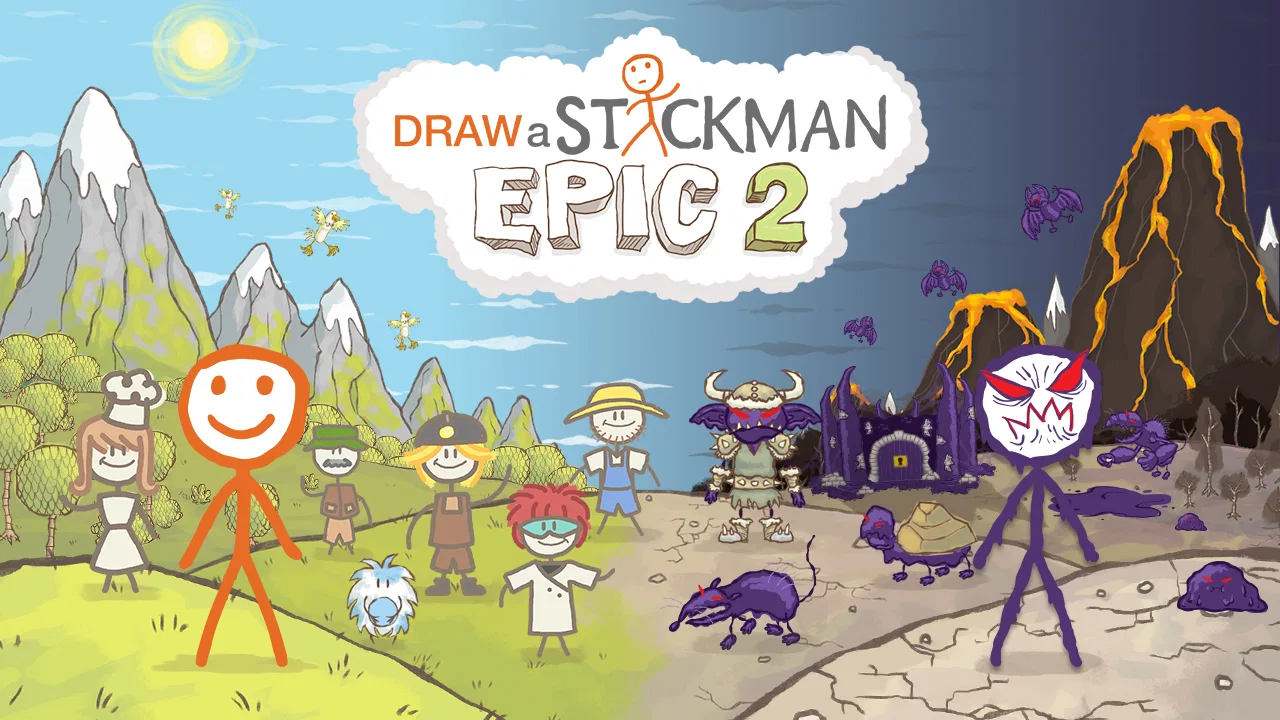
Draw a Stickman: EPIC 2
- 3.7
- Rating
- 10.00M
- Installs
- Free
- Price

 Analysis by App-foxy
I went into Draw a Stickman: EPIC 2 expecting a small, disposable drawing game, and the first sessions did a good job of proving me right in the best possible way. It is quick to understand, playful without being childish, and built around the satisfying idea that my own sketches can become useful objects inside an adventure. The appeal is immediate: I draw something, test it in the world, see what reacts, and then adjust my approach when the first idea does not work.
That simple loop gives this free adventure game a personality that many touch-screen games never quite find. It does not ask me to master a complicated control scheme before anything interesting happens. Instead, it makes the act of drawing part of the problem-solving. After the novelty wears off, though, the important question is whether that idea remains enjoyable when I return repeatedly. My answer is positive, but qualified: this is a charming game to keep available for occasional creative play, not necessarily a daily habit for every player.
A first week built around curiosity
The opening appeal comes from the contrast between rough drawings and a responsive adventure setting. I do not need artistic skill to participate. A crooked line or clumsy shape can still feel meaningful because the game treats drawing as an action rather than an attempt to judge my artistic ability. That makes the first play session approachable for children, casual players, and anyone who usually avoids games that demand fast reflexes.
You May Also Like

 Blood Strike: 2.5 Anniversary
Blood Strike’s Loadouts Turn Every Drop Into a Tactical Gamble
A close look at Blood Strike’s custom loadouts: how fast access to signature weapons reshapes its battle royale rhythm, rewards preparation, and narrows the gap between fights.

 Pandora - Music & Podcasts
Pandora’s Music Is Easy to Start, but Harder to Recover
Pandora’s strength is its low-effort path from a seed to a station. Its weak spot is how much confidence it asks you to place in connection, setup, and quiet recovery.

 8 Ball Pool
 Is Built on Rivalries, Rematches, and Routine
A close look at the rivalries, rematches, shared routines, and unanswered safety questions that turn a quick pool match into a persistent mobile community.

 Samsung Music
’s Quiet Strength Is Playing What You Already Own
Its reach comes less from spectacle than from dependable access to a personal library. That simplicity is both the app’s strongest retention engine and its ceiling.

 AccuWeather: Weather Radar
AccuWeather Review: A Quick, Clear Forecast for Everyday Decisions
For everyday plans, the best forecast is the one you can understand quickly. AccuWeather makes rain timing, radar, and local conditions easy to act on, with a few trade-offs.

 Hill Climb Racing
Why Hill Climb Racing Still Turns Crashes Into One More Run
A tiny car, a bumpy hill and one more upgrade: Hill Climb Racing keeps resurfacing because its simple chaos makes every near-miss feel personal.
More From Our News Desk
View All News


What kept me interested during the first week was the feeling of experimenting rather than simply following instructions. When I encounter a problem, I am encouraged to think about what kind of drawing might help. The best moments are not about producing a beautiful picture; they come from realizing that a very basic mark can change how I interact with the scene. That gives the adventure a light puzzle quality without turning it into a dry collection of logic exercises.
The game is especially easy to recommend for a short break. I can pick it up without remembering a long control sequence, play through a small stretch, and put it down again. This is useful on a phone, where a game often has to earn attention in brief visits. It also makes the experience suitable for sharing with a younger player: one person can suggest an idea while the other draws it, creating a more social activity than the solitary store description might suggest.
There is a practical advantage to the drawing system as well. It gives children room to make mistakes without making every failed attempt feel expensive. A failed sketch is usually part of the learning process. Instead of treating experimentation as wasted time, I found myself trying another shape or changing the timing of a gesture. That low-pressure structure is one reason the Everyone content rating feels appropriate, especially for families looking for something gentler than combat-heavy adventure games.
How the drawing mechanic holds up beyond the novelty
Drawing on a phone screen is not always precise, and the game has to work around that limitation. In my experience, the most enjoyable solutions are the ones where the drawing itself is broad and readable. I could focus on the idea behind a tool rather than worry about creating a perfect outline. Still, players who expect a highly exact sketching experience may find the touch controls less satisfying than a dedicated drawing app or a game with conventional buttons.
The important distinction is that this is not a digital art studio. The drawing exists to support exploration. If I approached it hoping to spend time refining illustrations, I would probably be disappointed. If I treated each sketch as a quick instruction to the game world, the limitations became less distracting. That trade-off is central to deciding whether the game will last on my device.
During the first week, the strongest motivation was discovery. I wanted to see what the next situation would ask me to draw and whether an unexpected solution would work. That curiosity carries the early experience well, but it naturally fades once I understand the basic rhythm. The game then needs to rely on its level variety, its sense of humor, and the pleasure of revisiting the drawing mechanic from a different angle.
For a free game from Hitcents, the presentation feels focused on the central idea rather than on overwhelming me with menus or systems. The current version is 1.6.6, and its large audience suggests that the concept has reached far beyond a tiny niche. The game has more than ten million installs, while its average rating sits at 3.8 from roughly 378 thousand ratings. Those figures do not guarantee that every player will enjoy it, but they do match my impression that this is an accessible, recognizable adventure rather than an obscure experiment.
What gives it recurring value
After the first month, I would not return because I need another conventional progression system. I would return because the game offers a different kind of interaction from most mobile adventures. Many alternatives ask me to tap attack buttons, move a character through familiar platforming patterns, or solve puzzles using a fixed inventory. Here, the question is more personal: what can I draw that might help right now?
That difference gives the game recurring value for players who enjoy creative problem-solving. It is a good choice when I want something playful but do not want the pressure of a competitive leaderboard, a demanding action game, or a long role-playing commitment. A child can approach it as a drawing toy, while an older player can appreciate the small satisfaction of testing an idea and seeing the environment respond.
A realistic everyday use case is an evening when I have only a few minutes before putting my phone away. I can open the game, revisit a section, and focus on solving one obstacle instead of committing to a full campaign session. It also works during travel or waiting periods because the central interaction is self-contained and does not require me to build a large strategy around external events. That makes it more durable than a game whose enjoyment depends entirely on keeping up with a live schedule.
There is another useful way to play it: use the drawing as a prompt for conversation. When I played with someone else nearby, the fun was not only completing the objective. We compared ideas, laughed at awkward sketches, and tried to predict which drawing would be useful. That makes it a better family or casual social game than its single-player adventure label might imply, even though the actual interaction remains centered on one device.
The recurring value is less convincing for players who need constant escalation. If I want new competitive challenges, deep character builds, or a large collection of equipment to manage, this will feel modest. Its strength is consistency, not endless complexity. The same basic creative premise remains the reason to play, and that is either a refreshing focus or a limitation depending on what I want from a mobile game.
Maintenance, spending, and the effort required to keep playing
One reason I can imagine leaving this game installed is that it does not demand much maintenance from me. I do not need to organize a daily routine around it to understand what is happening. There is no appeal in pretending that it is a permanent obligation; its best role is as a game I can revisit when I want a light, inventive distraction. That low maintenance burden helps it survive the period when the initial excitement has settled.
The game is free to download, with individual in-app purchases ranging from $0.99 to $99.99. That wide range is worth noticing before handing the phone to a child. I would review the purchase settings on the device first and make sure the player understands that optional spending can be part of the experience. The free entry point makes it easy to try, but the presence of purchases means it should not be treated as automatically cost-free in a family setting.
For my own use, the sensible approach is to judge the core experience before considering any purchase. I would not spend simply because the game has become familiar; I would only consider it if an optional item genuinely improved the way I wanted to play. This is especially important here because the creative drawing mechanic, rather than ownership or collection, is the main source of enjoyment. Spending does not replace the need to like that mechanic.
The maintenance question also includes patience. A drawing game can become less appealing if I approach every obstacle as something to solve immediately. I found it better to pause, try a simple idea, and accept that some attempts would look ridiculous. That mindset reduces friction and helps the game remain relaxing. Players who dislike trial and error may experience the same mechanic as repetition instead of experimentation.
Where fatigue begins to appear
The largest long-term risk is that the central trick can become predictable. Once I understand that drawing is the main answer to most situations, the surprise shifts from discovering the mechanic to seeing how each new situation uses it. If those situations do not feel sufficiently different to me, the game can start to resemble a sequence of variations on one idea.
Touch input can add to that fatigue. When a drawing does not behave as I intended, it is not always obvious whether my idea was wrong or my gesture was imprecise. That uncertainty is manageable during a playful session, but it can become irritating when I am trying to finish a particular challenge. Players with larger screens or a stylus may find the act of drawing more comfortable, while those using a small phone may need to simplify their sketches.
The game may also disappoint anyone looking for a serious adventure atmosphere. Its tone is deliberately cartoon-like, and the stick-figure presentation is part of the charm. I would not choose it over a story-focused adventure with detailed characters, dramatic music, and a more elaborate world. The rough visual style is not a weakness by itself; it simply tells me what kind of mood the game is designed to create.
Another source of fatigue is the gap between a clever first solution and repeated attempts after it fails. The game is most enjoyable when I feel free to experiment. If I start treating every puzzle as a test that must be solved in one exact way, the experience becomes less playful. My practical tip is to change the drawing concept rather than repeatedly redraw the same shape. A new approach usually fits the spirit of the game better than trying to force a technically perfect version of the first idea.
This is also where alternative games may be a better choice. For pure drawing, I would use an art-focused app. For fast action, I would choose a platformer with tighter controls. For long-term progression, I would prefer an adventure game with deeper upgrades or a more substantial story. This title sits between those categories: it uses drawing as an adventure tool, and its value depends on whether that unusual middle ground appeals to me.
Who should make room for it?
I think it earns a place on a phone for families, casual players, and anyone who likes puzzles with a creative twist. It is also a good recommendation for someone who says they are “not a gamer” but enjoys doodling, experimenting, or solving small problems without time pressure. The Everyone rating makes it easier to consider for younger players, although I would still manage the in-app purchase settings before sharing the device.
It is less suitable for players who want a demanding challenge from the start. The relaxed presentation and approachable controls are deliberate, so the game may feel too gentle for someone looking for intense action. I would also skip it if my main goal were to practice drawing technique. The sketches are functional tools inside an adventure, not finished artwork, and the game does not replace a proper creative application.
The developer, Hitcents, has built the experience around a clear identity rather than trying to imitate every popular mobile genre. That focus is valuable. I always know why I am playing: to explore, draw, test an idea, and see the result. The trade-off is that there are fewer reasons to return once I no longer feel curious about the next situation. It is a focused game, not an all-purpose entertainment platform.
One practical tip is to play with a finger gesture that is easy to repeat rather than attempting elaborate drawings. Simple shapes are faster, easier to recognize, and less frustrating when the screen is crowded. Another is to treat failed attempts as information. If a drawing does not help, I ask what part of the idea was useful and change only one element at a time. That turns the game into a small, satisfying process of observation instead of random tapping.
My long-term verdict
After the novelty fades, Draw a Stickman: EPIC 2 remains worthwhile as an occasional adventure with a distinctive creative hook. I would not describe it as a game that must become part of my daily routine. Its lasting strength is that it can sit quietly on the device and still feel inviting when I want something light, unusual, and easy to resume.
The free price makes trying it straightforward, while the Everyone rating broadens its audience. The purchase range means families should pay attention to spending controls, and the average rating shows that the experience is appealing but not universally loved. I think that balance is fair: the concept is memorable, yet the touch-drawing limitations and the possibility of repetition will matter to some players.
My final recommendation is to install it if the idea of drawing solutions inside a cartoon adventure sounds more appealing than conventional combat or platforming. Give it time to work as a playful experiment, not as a deep long-term progression game. The lasting value comes from creative problem-solving in short, low-pressure sessions, and that is enough to justify keeping it available for the right player.
In my case, it earns that space because it offers a kind of interaction I do not get from the usual mobile alternatives. I may not open it every day, but when I want to doodle my way through a small adventure, it still has a clear reason to be there.
FAQs for Draw a Stickman: EPIC 2
01What is the main objective of Draw a Stickman: EPIC 2?
Draw a Stickman: EPIC 2 is an adventure puzzle game where you create your own stickman character to navigate through various levels. The main objective is to solve puzzles, defeat enemies, and explore a colorful world using your creativity and drawing skills. Your drawings come to life and help you overcome obstacles and challenges.
02How does the drawing mechanic work in the game?
In Draw a Stickman: EPIC 2, you use a virtual canvas to draw your character and tools. Once drawn, these elements become part of the game, allowing you to interact with the environment. The game provides various colors and pencils to create your drawings, and each creation can influence your journey and puzzle-solving strategies.
03Is Draw a Stickman: EPIC 2 suitable for children?
Yes, Draw a Stickman: EPIC 2 is designed to be family-friendly and is suitable for children. It encourages creativity and problem-solving, making it an excellent choice for young players. However, some puzzles may be challenging, so younger children might need assistance. The game’s colorful graphics and engaging story are appealing to all ages.
04Are there any in-app purchases in Draw a Stickman: EPIC 2?
Draw a Stickman: EPIC 2 does offer in-app purchases. These are primarily for additional content such as new levels, drawing tools, or customization options for your stickman. While the core game provides a complete experience, these purchases can enhance gameplay and offer more creative possibilities.
05Can I play Draw a Stickman: EPIC 2 offline?
Yes, Draw a Stickman: EPIC 2 can be played offline. This makes it a convenient option for gaming on-the-go without needing an internet connection. However, some features, like updates or certain in-app purchases, may require an internet connection to access.
Pros
- Creative and interactive gameplay.
- Vibrant
- colorful graphics.
- User-friendly drawing tools.
- Engaging storyline and puzzles.
- Regular updates with new levels.
Cons
- In-app purchases can be costly.
- Limited character customization.
- Occasional lag on older devices.
- Drawing precision can be tricky.
- Some puzzles are repetitive.

Draw a Stickman: EPIC 2
Gallery